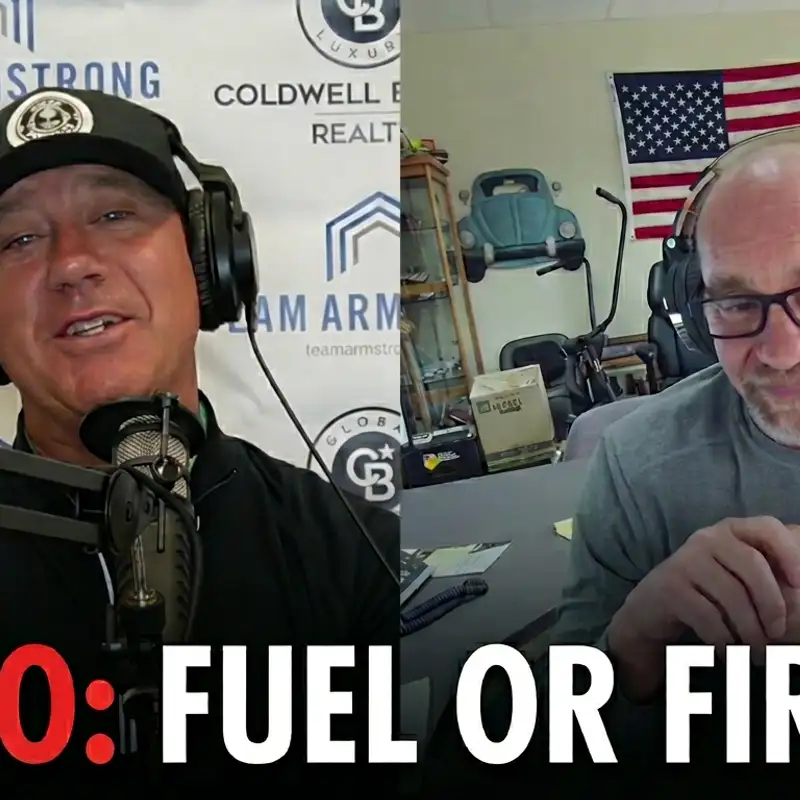
OGSR Episode #150 Ego ... Magic Episode | Apr 16, 2026
Download MP3Blair Armstrong (00:44)
All right, all right, all right. Good morning. Good afternoon. Good evening. Wherever you may be when you're watching this or listening to this or both. This is your first time here. You have just reached the best damn podcast you've ever heard or seen before in your whole life. Again, if this is your first time here, we are known as old guys still rock better yet. OGSR. And today we have broken another barrier.
Brent Wright (01:13)
Mmm.
Blair Armstrong (01:13)
We are on
episode number 150. It's 150. I want you to look up all the podcasts that have been generated in this world and you tell me how many out of all of them have hit 150 episodes. So you may not be the biggest and greatest, but we are continuing to grow every single week. We are going to continue to change lives, not only other people's lives, but our lives as well every single week. So if it's your first time here.
We have 149 episodes besides this one. So this is 150 go back. Check us out Hit that subscribe button hit that notification bell if it's Spotify YouTube iTunes I heart whatever you listen to your podcast or watch your podcast on just hit that subscribe button right now and then now we're gonna get into it. again, I am Blair Armstrong
Brent Wright (02:03)
and go back
and watch that train wreck first episode.
Blair Armstrong (02:07)
Yeah, watch that one first. But
and then go watch episode 149 and see how much we've evolved. So so again, if you don't know who I am, I'm Blair Armstrong of Team Armstrong, Cold Banker. You kind of see that behind me. I am a global luxury specialist in the world of residential real estate located in the beautiful, beautiful Coachella Valley that is basically Palm Springs, Palm Desert, Lakita, Indio, Rancho Mirage, somewhere, somehow. Most of you have been there or have heard about it.
Brent Wright (02:12)
Yeah, exactly.
Blair Armstrong (02:36)
So if you are, since we do not have sponsors or advertisers, if you are looking in the world of real estate in this area or even outside this area, because we are global, reach out to me. I'd love to help you out with that. That's how you could support us and this show. So the other guy on this episode has been a good friend of mine for gosh darn over 30 years, almost 30 years, Brett Wright of Brett Wright Incorporated. He is the other host of this show. He is located in beautiful.
beautiful Eugene, Oregon. I don't know if it's raining. We're going to get into that in a little bit. But man with many hats. And this is kind of how why we continue to touch people's lives and give them golden nuggets. So multiple business owner from body shops to detail shops to payroll companies. He is the financier. I said financier, not owner of Wright Wellness Center. If you're in that
Gene Springfield area and you're looking for a new way to get healthy. Actually probably a better way to get healthy, not only working out, with peptides and farm forever treatment, cold plunges, all the other things that you're hearing about now. Go check out right wellness center. he is also a part of a venture capitalist group, that bought a company called busted at teas.com. The novelty t-shirt company. If you haven't checked that out, check that out. By the way, everything that I mentioned here,
are not paid sponsors as of yet, as of yet. But most, I mean, I think the biggest feather that Brent has in his cap, and you'll hear that today and it said, go back and watch 149 episodes minus episode number one, is really check him out because he's a great personal coach and a great business coach. And you'll see that through today's episode again and all the other episodes that we have there.
Brent Wright (03:53)
Mm-hmm.
Blair Armstrong (04:17)
joke with me say this, but if he's not a fit for you, you can always call me. So that was a big intro this morning. We're going to get into our topic here, which is we're really talk about ego for a little bit. first of all, I want to see how you're doing, what's going on in your world, how's the weather, how's busted tees, what is going on.
Brent Wright (04:37)
Yeah, so the weather is bipolar in the springtime as it always is in Oregon. It seems to be a little more bipolar this year. Last week we had 80 degree weather, 82, 83, 84, and this week we're in the 40s and 50s. And we've had some weird, weird wind patterns. Yesterday there was almost a little mini tornado up at the ranch.
Super weird, knocked over three chairs, left eight.
Blair Armstrong (05:04)
That's just trippy, right?
Brent Wright (05:05)
Like one right next to it didn't get knocked over, but three others next to that got knocked over. The whole thing was weird. had 35, 40 mile an hour winds last night. And then all of a sudden the rain came in and it just dumped in it. We have skylights in our bedroom. So it's very, very peaceful to sleep too. Um, but knowing that all the cows are not happy being out in that weather. So, yeah, but yeah, we're.
Blair Armstrong (05:22)
Yeah.
Yeah.
Do they typically try to find shelter or are they just out there?
Brent Wright (05:37)
They're dumb, dude. Like they have shelter, but they will stand half in and half out of the shelter. I don't even understand it. Like it's just, yeah. They, yeah, they're, I would tell you the only dumber animal is sheep. You can give them a shelter and they won't even go under it.
Blair Armstrong (05:43)
Oh, really? Huh. Not in their DNA.
That's crazy, huh? Wow.
Brent Wright (05:56)
Yeah,
super weird. But yeah, business is good. Cash flow is working. My coaching business has been very fruitful just from the ability to help people. My current coaching clients are actually having me coach their employees now. So I'm coaching the coach and then the coach is having me coach.
other people under them, which is super cool. Very, very, very rewarding. And on our topic today, had an opportunity yesterday to interact with one of my coaching clients who had to have hard conversations with his employee. And it kind of went how I thought it was going to go. I don't think it went how my client wanted it to go or thought it was going to go.
Blair Armstrong (06:21)
That's awesome,
Yeah.
Right?
Brent Wright (06:48)
And the biggest impasse was this person's ego. They felt as if they were all that and a bag of chips as the saying goes. And they found out very, very quickly that business owners don't like to be strong armed. And it didn't go well for that person. So ego, it could be a good or bad thing.
Blair Armstrong (06:52)
Yeah.
So yeah,
Brent Wright (07:11)
Fuel or fire?
Blair Armstrong (07:12)
yeah, right. So episode number 150, ego, right? You just got this stuff of those, this life of businesses that fuel or fire. So when you hear that word, and because I know that it's different with everybody, we have a thousand different answers if we asked a thousand different people what ego would be. So when you hear ego, what do you think of? What does it bring up in your mind?
Brent Wright (07:38)
Well, in my mind, ego is a good thing and can be a bad thing. It's as we, the notes that we shared with each other, it's built empires and it's also burned them to the ground, right? So we've seen it historically with kings, with rulers. We see it today in our politics, right? So a lot of people like Trump's ego and a lot of people.
Blair Armstrong (07:50)
Uh-huh.
Yeah.
huh.
Brent Wright (08:08)
don't like Trump's ego. I think to be a good leader, you have to have some level of ego, but it's a balancing act. ⁓ You know, and the question that comes up is, are you using your ego as a tool or is it using you as a tool?
Blair Armstrong (08:18)
Yeah.
Yeah, and I think that's where you go back to, especially let's go back to your business conversation and then we'll get into relationship portion of this as well, right? But on the business side of it, I mean, you can go ahead and have this giant ego or to where you're here to serve me.
Brent Wright (08:42)
Mm-hmm. And that was the conversation yesterday.
Blair Armstrong (08:43)
⁓ and
yeah you know and that is not going to go over well because as soon as you kind of come under that you're here to serve me which in essence the employee is there to enhance the the owner's business but when you come off with that and you kind of state that maybe pump up your chest and it's you know this is about me you want to be here without me blah blah blah blah then
Brent Wright (08:57)
Mm-hmm.
Your business will fail without me
was the topic of conversation yesterday.
Blair Armstrong (09:12)
from the employee to the boss or from them?
Brent Wright (09:13)
From the employee to
the boss, yeah.
And that's a tough road.
Blair Armstrong (09:15)
So
that is a tough road. don't, obviously you can probably enhance as you know more about the situation that can help a lot of people out on that. But that's a tough road. Somewhere along the line, he was given some responsibility and led to believe that he was more important. Not saying that this employee wasn't important, but he was more important than he really is.
and
Brent Wright (09:42)
Well, we're all replaceable, right? So.
Blair Armstrong (09:44)
Well, yeah, we're one decision away, right?
Brent Wright (09:46)
We're always, and what's the first thing that happens as soon as you die? You're replaced by something or someone, right? Or people start divvying up your crap, right? And so, your ego is only, it only works while you're there.
Blair Armstrong (09:51)
Ha ha ha.
So let's walk me through this conversation, because I love this.
owner is grooming their star employee and getting them out to kind of building leadership into them. Maybe having it, maybe even having a leadership mindset. Don't know the scenario of just kind of guessing out here, but having this servant leader mindset to it really wants them. When we talked about this last week, I get people to join my team and I tell them flat out at the end of the day, I want you to be better than me.
Brent Wright (10:10)
Mm-hmm.
Yeah. Yep.
Blair Armstrong (10:31)
But now I'm sitting here listening to this like, okay, yes, I do want you to be better than me, but where do we keep the line is at the end of the day? Yes, I want you to be better than me, but I'm still the captain of the ship. I don't want to come off that I'm the captain of the ship. I do want your input. I super this. So where is that fine line of like, okay, I want you to be better. I want you to be better than me, but there's still a pecking order that we have to respect on both sides. How did you coach through that?
Brent Wright (10:57)
Mm-hmm.
Well, didn't. So I think I coached reasonably well. Unfortunately, this employee became adversarial and very aggressive and dropped four letter adjectives throughout the conversation and then got up, slammed the door and drove out of the parking lot in a blaze of glory. And, and that was it. Ultimately this person's pride and ego drove all of their responses.
Blair Armstrong (11:09)
Okay.
That was it.
Brent Wright (11:29)
So again, remember ego is just a tool. So you could have set back, this employee could have set back and took the feedback and then used it and applied it to the situation to get a better outcome. But instead chose to burn it to the ground. We talk about burning things to the ground, right? And back to our subject, is it fuel or is it fire? This employee chose to use it as fire.
Blair Armstrong (11:31)
Right.
Right.
Brent Wright (11:56)
and lit the whole place on fire.
Blair Armstrong (11:58)
which we talked about too, is there some sense that if kind of what your surroundings are that somehow what we see or what we're witness to or what we witness, entitlement involved somewhere along the line there, that they see all these things, they see all these people that get these responses, you're good job. And maybe the end customers are saying, hey, man, you're amazing. It's one of the best things that's happened to this company. And all of sudden they start taking over ownership role.
Brent Wright (12:12)
Mm-hmm.
Blair Armstrong (12:26)
to where they feel like, I'm running this show. If he wasn't here, I could do this, this, this, and this, and this. How has you, so with that being said, I'm thinking this out loud, what that being said is when that employee feels like they really are taking on our ownership role.
How do you as a boss come back to that employee and you are doing a good job. I really need you. What type of the feedback to help us become better?
Brent Wright (12:48)
Well, it's all polishing, right? And so you have to want to be polished. Again, utilizing ego as a tool, it's not just arrogance, it's identity, self-perception and pride. And we've done a podcast about pride, right? It just makes you proud. Sometimes pride will get in your way. And with this situation, pride was the driver for the whole conversation.
Blair Armstrong (12:52)
Right?
Mm-hmm.
Brent Wright (13:12)
It was, you can't do this without me. You need me. You need to take the things that I'm bringing to you and act on them. And when you don't act on them, I'm offended.
And that's an unhealthy ego, right? So a healthy ego is confidence, standards, and self-respect. An unchecked or unhealthy ego is insecurity disguised as dominance. So that's what happened in this situation is this person tried to assert their dominance in the conversation because they're insecure. They're an insecure person who needs validation at every turn. And when they don't get the validation, they lash out.
Blair Armstrong (13:23)
Just, yeah.
Okay, in this scenario, because we don't know who we're talking about, is in this scenario, the employee was so good, even though that he kind of had these desktops probably once in a while, that the owner said, man, I'm just gonna kind of let this slide, it's a personality, I'll figure it out later. And just let it build and build and build to the point that there was no return. Yeah.
Brent Wright (14:11)
and it build to the point that it was breaking, right? And
so that's the problem is that unchecked ego really will kill the deal for anybody. So, you know, the old saying silence is golden. And so that's how you check your ego is be inquisitive. We talk about being curious like a four-year-old.
Blair Armstrong (14:22)
Right.
Brent Wright (14:35)
This person wasn't curious. They didn't care. They did not take the feedback well and they felt like any feedback was adversarial. And to the same point, one of our talking points is most men don't have too much ego. They have fragile egos. And this person's ego was broken very, very quickly because the conversation started out as,
carrot stick, carrot stick, right? And so the carrot was you're doing a great job, but here's a write-up, a formal write-up on three things that need to be checked at the door. And that went reasonably well. But then we're going to step you back into a different role. And in that different role means that you're gonna lose some pay.
That sent this person into an escalation where they didn't even want to hear that there were opportunities for them to get that payback based upon checks and balances. And their ego was so large in the room that it overpowered everything, including their ability to think and rationalize that this might be an opportunity for them.
Blair Armstrong (15:46)
What's the question going into this and trying to keep egos at bay with everything and understand that there's probably a backstory to this guy that's been kind of kicked and pushed around on the backside and he comes to work and feel like this is kind of his purpose. And then when this is presented to him, it's like, God, no one really understands how much I want to give. And I just keep getting told, no, no, And that can break an ego. But was there a purpose?
Brent Wright (15:56)
Mm-hmm.
Blair Armstrong (16:14)
along this process, was there a question asking, how do you think that you're doing? What are some of the things that are your strong points and what are some of the things that you think are your weak points that you need help on? Was that conversation ever had?
Brent Wright (16:21)
Mm-hmm.
Well, yeah,
so we had that conversation and there were a lot of strong points as always, right? And there were no weak points brought up.
Blair Armstrong (16:35)
Yeah, sure.
Brent Wright (16:40)
He was very easy to bring up strong points and not so easy to bring up failures or things that he needed to work on. So I would tell you that you probably need to create a list. What are your strengths and what are your weaknesses? A typical SWOT exercise, Strengths, weaknesses, opportunities, and threats. People that don't think along those lines and validate their existence based upon a SWOT analysis in a company,
Blair Armstrong (16:55)
Right.
Right.
Brent Wright (17:07)
aren't always going to feel like they're not, that they're giving more than they're getting.
And that's a problem.
Blair Armstrong (17:13)
Yeah, I mean, I just keep going back to this. mean, because this happens so much in business, right? I mean, this is not just a one-off thing. This happens every day in business, happens every day in relationships, whatever to it. But I always go back to what we talk about so many times and have multiple episodes and that's on communication. Somewhere along the line, got very, stopped raising the, we stopped raising the thermostat. It got comfortable on both sides.
Brent Wright (17:22)
every day.
Mm-hmm.
Mm-hmm.
Yeah.
Blair Armstrong (17:39)
both
sides, I ran this thing to it. And then you realize that I got too comfortable. And now I have to kind of hold not only my feet if I'm the boss to the fire, but I also have to hold the team member or an employee's feet to the fire as well. We need to make some adjustments because it's probably got too far down the path and you're trying to make some, some fourth quarter adjustments when it should have been made in the second quarter, right?
Brent Wright (17:57)
Mm-hmm.
Well,
it's hard to pull anything back away from people once you give it, right? And the problem is, is that this person's ego was, it took over anything rational. It became so large that it was just, it was fuel to the fire instead of fuel in a positive way. You know, it's...
Ego is a big destroyer of people. mean, let's look into history. Napoleon, little man, huge ego. And his ego ultimately destroyed not only him, but his empire.
Blair Armstrong (18:42)
We can talk about another one just happened recently, I mean, realistically, we'll talk about politics again, if you like or don't like Trump, his ego is getting in his way. His people around him are feeding that and not really his message. There is, if you peel back to me.
Brent Wright (18:51)
Yeah.
Blair Armstrong (19:01)
And this is not I'm not siding with him one way or another. But if you peel back his message, I think there is actually some care in there. But the people surrounding him are feeding that ego. So he keeps thinking he's doing the right thing over and over again. Another portion of that, which really just happened over there, we've seen the rise of a fall of one of the greatest golfers ever in Tiger Woods. Right. His people around him, you know, is all the accolades that he got. mean, realistically, we probably will never see a net. Well, another golfer that changed such the game.
Brent Wright (19:19)
⁓ Yeah. Yup.
Blair Armstrong (19:30)
in such a way that he did, but the decisions because he's tasted, he's seen greatness, he's tasted greatness, he's been in greatness, and now things are starting to disintegrate, but his ego will not let that go, and he's making decisions that are not only harmful for himself, but potentially harmful for others as well.
Brent Wright (19:48)
Well,
it's a wake, so no different than a boat. A boat at speed produces a wake, and that wake can either be a positive thing if you're a wakeboarder, or a negative thing if you're a skier, right? And so it's the wake that happens, it's the fallout that happens behind all of this. So the problem with ego as a destroyer, it's really easy to point out the positive things of ego. We see people...
Blair Armstrong (20:02)
Right? Yeah.
Brent Wright (20:17)
you know, rise to power and all those things. But ego is a destroyer. People stop learning. They think they know everything, which has happened yesterday in our conversation with that employee. It kills relationships. know, pride is greater than connection. Which happened again in that conversation, you know, it killed the relationship between that employer and that employee. It can destroy businesses.
People that don't listen to customers anymore, ignoring team input, refusing to pivot.
Blair Armstrong (20:45)
Yeah, that's a big one, right?
Brent Wright (20:47)
Yeah. And we're seeing pivoting necessary in today's economic environment. People that don't pivot and stay static are going to die. And we've seen it in small businesses across the board, pick something, right? So you're seeing laundromats who have been in business for 50 years and they're not pivoting. And you're seeing laundromats now have
Blair Armstrong (20:58)
Yeah.
Brent Wright (21:14)
What do you call it? Like a music night. They're having free food there. They're driving people in. then there's other people who are just, we're just a laundry mat. We're not a place for people to hang out. What do you do for an hour and a half while your stuff gets washed, right? And so people sit on their phones and now they're seeing other opportunities to go somewhere and do something while their clothes are being washed. You must pivot in business. It's no different. You know, if I just continue to detail cars,
Blair Armstrong (21:18)
Right.
Right.
Right?
Brent Wright (21:43)
and clean cars and I didn't pivot into ceramic coating and I didn't pivot into PPF coating and I didn't pivot into headlight restoration. I would just be the guy that cleans cars and I would never make any money and I would eventually die. Same thing that's happened in the body shop industry. The insurance portion of the body shop industry is dying. I saw this 10 years ago and we pivoted into restoration and fabrication.
Blair Armstrong (22:00)
Right?
Brent Wright (22:12)
and that's been a huge driver. If I had let my ego go unchecked, I would say, I'm the best body shop in town and I'm going to be the best body shop and then I'm going to die because I'm, there's other good body shops in town that are doing the same exact thing that I'm doing. And how, and how do you differentiate yourself if you choose not to differentiate yourself? The only way is to die.
Blair Armstrong (22:20)
Yeah. Yeah.
What?
So, I mean.
You brought this up to me a couple years ago because obviously real estate agents are like insurance agents, right? There's a lot of us everywhere. But what is differentiating your stuff like this? And even though that you may have a really good quarter, you may have a really good year, that can change drastically quick. And you said something, you're gonna, I'm gonna.
Brent Wright (22:48)
Mm-hmm.
Blair Armstrong (23:01)
give you the thing that that sticking out and be an agent of change. Like real estate is always changing. I'm an agent of change. He said that to me a couple of years ago. Right. And so we were constantly we're trying to do different things. Social media. Yes, you can talk about selling houses, but where where are you becoming a resource? And that's where our constant conversation with us is, is that we do good. We do really, really good. mean, on paper, if you look to us, we'll go pound for pound for probably in the top
Brent Wright (23:09)
Yeah, that should be your tagline is what I told you, right?
Blair Armstrong (23:31)
10 % of our area. It's awesome to know, but I also have learned very well that could change drastically overnight. It could all go away with one decision or thinking that you're the best. I will flat out say we do a really good job, but we're also looking to get better at the same time.
I'm proud of what we've accomplished, but I know that we have a long way to go. And that's a hard thing when things are super comfortable and you have a bunch of stuff that's right now we're in a really good spot. But I know that we have to like, okay, this is great right now. What do I have to change starting right now? So when this ride gets over this thing that we're in right now, this great storm that we're having right now, when this gets over, how are we going to transition?
to become better and that we can keep this in essence on a constant upswing. We know that there's gonna be peaks and valleys on that stuff, what are the changes that we're making now? are the losses that we had? How are we absorbing those losses? And then how are we paying attention to those so we can make the adjustments so the next time that thing comes available, we were never greater than that situation, but we've learned from it.
and became greater. Does that make sense?
Brent Wright (24:47)
Well,
what, yeah, a hundred percent. So what you're saying, to summarize what you're saying is, is that you're still listening. You still have your ear to the ground and you're listening, right? Ego, if you had a big ego in this and said, I'm the best of the best and that's just it, period. Ego would make you deaf and business punishes deaf leaders. How many men do you know that have lost everything because they wouldn't admit that they're wrong?
Blair Armstrong (24:54)
Yeah.
Brent Wright (25:13)
Yeah, 100%. You don't end up in the back of a 79 Chevy pickup living in it because you listened to everything that everybody said and tried to adjust, right? Why is, I was wrong, one of the hardest things for most people to say.
Blair Armstrong (25:17)
You
Right.
When I made my bad decisions probably about six years ago and lived in a 13 by 13 square foot box, I mean, essence of it was a room on a very used mattress, my ego got in the way. And I had to not only own that, but I had to reach out to people that were not a part of it and make some massive apologies because they helped me along the way.
to get to the spot that I was at and.
my decisions washed it all away. And so all their hard work, even though that this decision did not essentially affect them, it was a slap in their face, like everything that we, all this time that we spent with you and you made this decision that basically said, F you in so many ways. I know those were hard conversations, massively hard because
Brent Wright (26:24)
Mm-hmm.
Blair Armstrong (26:27)
I know that even though that maybe it didn't affect them emotionally or financially and all that stuff to it, it was a disrespect and that was a massive blow to my ego. And so now going into things like this, I could be the number one agent in this valley right now, but that doesn't make me any better than the next agent down there.
Brent Wright (26:49)
Well, let's go back to our conversation when you were in that box. You're literally calling me, laying on the mattress, in the dark room.
Blair Armstrong (26:52)
Yeah.
Yeah. Yeah.
Brent Wright (26:59)
And he said, I don't know how I got here.
Blair Armstrong (27:01)
Yeah.
Brent Wright (27:02)
And I said, are you gonna let this moment define you or help to motivate you?
You're gonna stop talking about where you're at or you're gonna start talking about where you're gonna go. And I don't know that you made that decision that day. I think it was a few weeks later, probably six weeks later, you called me and said, all right, I'm done with my pity party and I'm ready to get out of this box.
Blair Armstrong (27:23)
Yeah.
And to this day, man, I have those conversations with myself every day.
Brent Wright (27:31)
Right, so do I. I drive past that 79 Chevy pickup every morning, and I've said this 150 episodes now, every morning I drive past that 79 Chevy pickup and it's a reminder, it's a humbling reminder of where I've been and where I wanna go and what I need to check at the door every single morning to make sure that I don't end up there again.
Blair Armstrong (27:32)
every day.
Boy, man, I just, I'm reliving all that situation. I remember the phone call. I remember where I was at and there's just the world's crashing around you. Like, mother trucker, what did you just do?
Brent Wright (27:58)
So I'm gonna give you, so what's that?
Blair Armstrong (28:13)
And I always go to a totally different scenario, but come to the same senses. I was bigger than everybody else. I was great.
Brent Wright (28:24)
Well, you probably had
this thought, is my identity is built on what I have.
and where I'm at.
And with that, ego will always be in control, always, right? Until it's not, until you make the decision that ego is not gonna control your narrative any longer.
Blair Armstrong (28:34)
Yeah. Yeah.
Yeah.
No, it's, it's, boy, it's tough when you're winning and things are flowing and you're getting accolades. you know, I'll give you a different scenario. We get invited to, pretty much every month. I maybe will miss one or two, but it's not there, but we get invited to top 10 luncheons out of our brokerage every, every month.
Brent Wright (29:04)
Yeah.
Blair Armstrong (29:07)
I have a hard time going because I in my head if I say this a lot you guys have heard this especially you guys have stuck with this through through 150 episodes job not done because my goal is here this was just another step to that goal should I should enjoy should I enjoy that win sure but I go back to remember I don't want to think that I'm finished
And it goes back to that 13 by 13 room with on the mattress talking to you. I never want to. I'm happy for what we want to, but I don't want that ego that that basically crushed me, licking the gutter moment that crushed me to seat back in. I want to be hungry every day and I always tell people, how's real estate? I go, sometimes it's fun. Sometimes it's dumb. Today is a fun day.
Brent Wright (29:59)
Mm-hmm.
Blair Armstrong (30:00)
Tomorrow could be a dumb day, but right now is we're going to constantly figure out how to get better and better and better because that that portion of my life. And I think that's what you said. I may have not made that change right away, but that there's still that that spot in my, in my soul. That as well as we're doing the biggest ones that we've had to date, I will never let that define who I am because if I got to that point, that means I can get to another point and I keep searching and it's super.
super hard.
Brent Wright (30:33)
Well, here's a question to ask yourself. And this is the question you might be asking yourself every day. If your business or your life disappeared tomorrow, would you still know who you are?
Blair Armstrong (30:45)
Yeah, now I would.
Brent Wright (30:47)
Right. But before you probably didn't. Yep.
Blair Armstrong (30:50)
No,
no, I do. It's our 40. It's our it's our conversations. The reason why we did this podcast, right? All these conversations that we would have when we're having bad days or we're trying to figure stuff out and stuff. And that's really that's the reason why we really started this podcast is because these are life changing moments. These are stuff that we go into. We get stuck in the loop. We just talk about this over again. And it really would, again, why this topic of today, which I really love that
you came up with and shared some notes on this is that it reignites that fire is like, yes, carry your ego, but carry it the right way and, and use it. People love to see confidence. People love to see confidence when I'm sitting down there talking to them. Right. But how, how blurry is that line once in a while?
Brent Wright (31:30)
It's just a tool in the toolbox.
Confidence is different than ego though.
It's very, very blurry. So I'm gonna give you some tools to un-blur this, some practical framework, if you will, some clarity. So number one, stay teachable. Always be the dumbest guy in the room. I've actually used that in conversations.
Blair Armstrong (31:49)
Clarity. We love clarity.
down.
Brent Wright (32:02)
Talk to me like I'm the dumbest guy in the room, because I might be in this subject. Number two, invite truth. Build people around you who will challenge you. You and I are always challenging each other. Number three, separate emotion from decision. Go back to the four decision-making process that's hanging on my wall. We've talked about it in prior episodes. Reach out to me if you want to know what those are and talk about those.
Ego reacts, leaders respond. So you gotta separate your emotion from every decision. Number four, practice humility under pressure. Even the pressure of winning, because there is a lot of pressure when you're winning too, not just when you're losing. Ask this daily question, number five, am I trying to be right or am I trying to win long-term? I ask this question often in another context.
Do I want it to be done my way or do I just want it to be done?
Blair Armstrong (33:02)
to talk about.
Because your way, again, win, win, win, win, win, win. My way is always working. Don't come to me with your idea, because it's my way or the highway.
Brent Wright (33:11)
Mm-hmm.
Here's some questions for you. We'll do a little Q and A. Employee pushes back on you. Ego or leadership?
Blair Armstrong (33:23)
It will, there is opportunities for leadership in there, but there is going to be ego like, dude, you have no idea. And not.
not asking the right questions, your ego will push that person or build a wall between you and that person.
Brent Wright (33:38)
Well, what's the first thing a boss usually says when an employee pushes back? I'm the boss, right? It's an opportunity for leadership. Customer complaint, do you defend or do you listen?
Blair Armstrong (33:45)
Yeah. Yeah.
Past, defend. Now we're listening. And I'm still working on that a lot because I go into defense mode. think everybody does, especially when you're coming to a spot where you know that you have the right knowledge and they're seeing it from 10,000 feet when you're looking at it from 50 feet and you sit there to defend. now I have, and I actually just had this experience a couple of weeks ago.
We have a really, we have the highest, the most expensive house here in Ironwood right now. And I had the owner and his wife and his daughter in the conference room and they were peppering, they were just question, know, press and press and press and I literally just sat there for 10 minutes while they were telling me stuff.
And I, and it was a lot because there's a lot, part of me like, no, we're doing this, this, this, this. And when I went back to it and I just sat back and listened, I said, you know, I understand that that makes sense. I can see where I can see where you're seeing that. And, I really listened for a little bit and I, I answered, said, I heard what you said, this, this, and this, are you open for me to kind of get to give you back some.
Brent Wright (34:53)
Mm-hmm.
Blair Armstrong (35:15)
responses or some ideas that I have with that. Long story short, it was supposed to be a 30 minute conversation. turned into a two hour conversation. There was a lot of great things. The great thing about this, built a better relationship between us, right? At the end of the day.
Brent Wright (35:30)
Listening builds rapport, right?
Blair Armstrong (35:32)
Right. And so I had that and then she texts me, the daughter texts me afterwards and she goes, I really appreciate you just listening to us to what our concerns were and then how you gave us the responses. She goes, thank you very much for that. That meant a lot. And that was huge. And then again, so here you go back to I'm really good at listening. And your ego comes like, okay.
Brent Wright (35:48)
Mmm.
Blair Armstrong (36:00)
Just take this as a learning thing. Yes, you're learning to become a better listener. You may suck on the other side of another situation of it, but take that and remember how you do that. And then go back and then train your staff, train your team members, train yourself into a personal relationship. So sometimes you just need to shut up, even though that you may be 1000 % right. And so that's a hard part when you are constantly winning, you've had success.
You might have been in the game for 20 something years, but someone has a response and you just want to like, well, I didn't become number one on accident. okay. Number one is fleeting. You can be a champion. Right.
Brent Wright (36:39)
Well, there's a time and place for that discussion, right?
And it may not be in every conversation. So here's one for you, which is really common right now in our economic times. Business downturn, blame or adapt.
Blame the economy, the economy sucks, everybody's sucking, everybody's fighting it. Or do you go, what can I do to adapt?
Blair Armstrong (36:59)
Teaching.
Yeah, we definitely have to adapt and there's also massive teaching moments in there and different insights. And I'm approaching that one right now is, you know, this is what I'm seeing and I understand what everybody else is seeing, but this is really what I'm seeing on boots on the ground here. you know, this is what I'm seeing. I'm not sure that it's correct. I'm sure starting to see a lot of it. There's a trend there. This is what we're following at this time. So.
We go back to this into yes, we have to adapt ⁓ to the down genres. Right.
Brent Wright (37:31)
Well, as the saying goes, adapt or die, right?
So you must adapt. So last one, partner disagreement, control or collaborate.
But you want to control. Yeah, everything that in your body, into your soul, wants to control the situation, Mm-hmm, yep, yep. So, yeah. Right, right.
Blair Armstrong (37:40)
Collaborate. 1000%. You want to control it.
Going through that right now too. Yeah. You're getting some good questions today, man. I'm like, have a scenario for every single one, but I'm sure that
I'm not the only one, right? I mean, everybody, everyone has this. It's just, there's certain things I get. Well, that's, you know, one of the many reasons I love our friendship and our collaboration in so many different ways is having these conversations really spurs and puts things on top of minus.
mind awareness, there's some stuff that I know I have to go back in because I do want to control. I want to have a standard. I want that standard to change every single day. And some people are not ready to have that standard in their life. So how do you collaborate with that and not let your ego get in the way? Yeah. Good questions. Right.
Brent Wright (38:35)
Well, your standards aren't theirs, right? So,
you know, in summary, I think we could both agree that ego isn't the enemy, but it's a fickle mistress and a terrible master, right? So don't let it own you guys. The goal isn't to eliminate ego, it's to put it in its place. Use it as a tool, use it as an opportunity moment.
Blair Armstrong (38:43)
Mm-hmm.
Yeah.
Brent Wright (38:58)
Because the same thing that can build your life can destroy it if you don't lead it first.
Blair Armstrong (39:03)
What we talk about often, this just came into my mind, what we talk about often, this is not a quick fix. It is something you have to constantly work on. It's a that you're going to make some massive mistakes. And there's also as good many times you're to have some massive wins. I will always go back to something that you do, something I do is go back and journal through the, about your day. What did you learn? What did I, what did I miss on? What do I have to go back on? What do I have to?
Own an apology, even though that you were coming back with the best intentions and say this did not come out the right way. I hear what you. Yeah.
Brent Wright (39:35)
Well, it's daily atonement, right?
Daily accountability to every situation.
Blair Armstrong (39:41)
Just remember how.
Brent Wright (39:42)
Mm-hmm.
That's the toughest thing when you're running fast, right?
So, yeah.
Mmm.
Mmm.
Yeah.
then make it important. Yeah.
Mm-hmm.
Well, that person needs to ask them some of themselves the same questions that we brought up here today. yeah, so final thoughts for me are ask yourself today, where is ego helping me and where is it costing me? Evaluate that and then go make a damn difference.
Creators and Guests